Contents
- Index
Discrimination vs. representativeness of testers
From Biplot Analysis, click Discrimination vs. representativeness. The following will appear on the biplot:
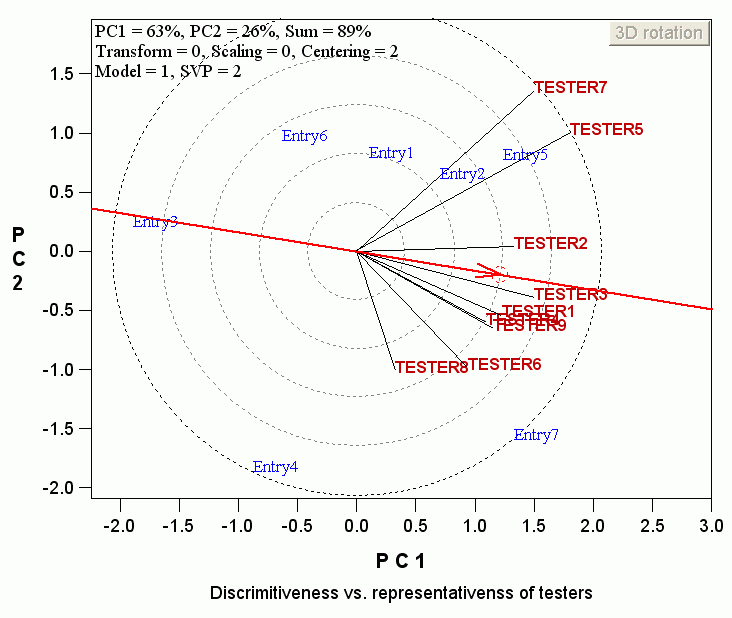
- The vectors for the testers;
- A small red circle indicating the position of the average tester, which is defined by the average PC1 and PC2 scores across all environments. This average environment can be regarded as a virtual environment;
- a thick red line that passes through the biplot origin and the average environment, referred to as the average-tester axis;
- a red arrow pointing to the average environment from the biplot origin;
Interpretation:
- The vector length of a tester represents its discriminating ability. Thus testers 5 and 7 are the most discriminating testers.
- The angle between a tester and the average-tester axis represents the representativeness of the tester: the larger the angle, the less representative the tester. Thus testers 3 is most representative whereas tester 7 the least representative.
- An ideal tester should be both discriminating of the entries and representative of the average tester. See Rank testers relative to the ideal tester..
In Depth:
This function applies only to GGE biplots with certain data scaling methods. Particularly, GGE biplot based on Standard Deviation scaled data does NOT have this interpretation.